
 admin
admin Why High-Resistance Rucking is the Ultimate Biomechanical Crucible
You can build a pristine physique inside a climate-controlled commercial gym, but an engine tested only on a flat, polished track will tear itself apart when forced into the mud.
Most modern fitness frameworks condition the human machine for isolated, predictable movements. You sit on padded machines, lift perfectly balanced iron bars, and step on motorized treadmills. You are training your muscles in a vacuum, completely insulated from the chaotic asymmetries of the natural world.
If you want to discover the true structural integrity of your biomechanics, you have to strap a heavy load to your back and step into the wild. You need to ruck.
The Evolution of Spatial Tension
Rucking—the simple act of walking with a weighted pack over distance—is not a fitness trend. It is a primal evolutionary baseline. For hundreds of thousands of years, the human frame was architected by the continuous demands of carrying loads over long distances: foraging, transporting meat, moving camps, and navigating high-resistance wilderness.
When you introduce a weighted pack to your frame, you change your center of gravity and alter the physical physics of every stride.
Unlike a machine gym workout, rucking creates a dynamic, continuous state of structural tension. Your core must constantly stabilize to counteract the rearward pull of the pack. Your glutes, hamstrings, and calves are forced into a sustained high-torque output to propel the load forward. Your upper back, traps, and shoulders must adapt to hold the straps steady.
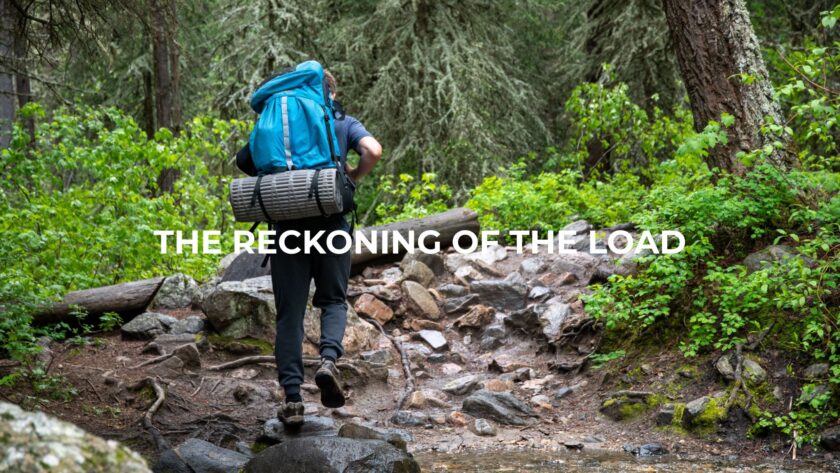
It is a full-body structural audit. If you have a hidden vulnerability in your kinetic chain—whether it’s weak ankles, deactivated glutes, or a compromised lumbar spine—the load will find it, expose it, and force a reckoning within a few miles.
The Subtropical Telemetry
Testing these protocols in an extreme environment, like the high-heat, high-humidity backcountry of the Florida Trail, scales the biological demands exponentially.
When you push through thick sand, navigate wet cypress terrain, and wade through swamps under a heavy pack in 95-degree weather, you aren’t just testing your muscles. You are stress-testing your metabolic engine and your cardiorespiratory efficiency.
- Accelerated Caloric Demands: Adding a weighted pack turns a standard walk into a profound metabolic stimulus, burning up to 3x the calories of walking alone without the joint-crushing impact of running.
- Postural Restoration: Rucking forces your shoulders back and down into proper alignment, naturally counteracting the forward-hunched “office posture” that destroys modern breathing patterns and spinal health.
- Nervous System Armor: Navigating unpredictable, uneven natural terrain fires up your stabilizer muscles and forces your brain to constantly map micro-adjustments in real-time. This conditions a level of resilient coordination that a sterile gym can never replicate.
The Tracking Protocol
We do not walk blindly into the backcountry. Every mile logged is a diagnostic data point.
As part of the MatrX development framework, I am actively tracking the real-world metrics of installing these missing routine components into my own schedule—measuring the exact adaptation timeline required to transition from daily chaos into an optimized, steady-state operator.
If you want to join this testing phase, don’t look for an overnight lifestyle miracle. Go back to Page 1 of your manual. Pick your single missing link. If your body is screaming for physical architecture, don’t overthink it: throw a controlled weight into a pack, step out the door into the heat, and start building your foundation at a steady, medium pace.
The data doesn’t lie. Get under the load, record the telemetry, and let the terrain forge the machine.